
The fourth-generation Hyundai Accent debuted at the 2010 Beijing Motor Show. Compared to its predecessor, it grew by 60 mm in length (to 4,340 mm), 5 mm in width (to 1,700 mm), and sits 10 mm lower in height (1,460 mm). This guide provides detailed fuse and relay box diagrams for the Hyundai Accent (fourth generation; RB chassis) covering model years 2011, 2012, 2013, 2014, 2015, 2016, and 2017.

Here you will find power distribution box locations, photos, and pinout schematics. The fuses responsible for the “Cigarette Lighter” and “Fuel Pump” are highlighted in bold.
Engine Compartment Fuse Boxes
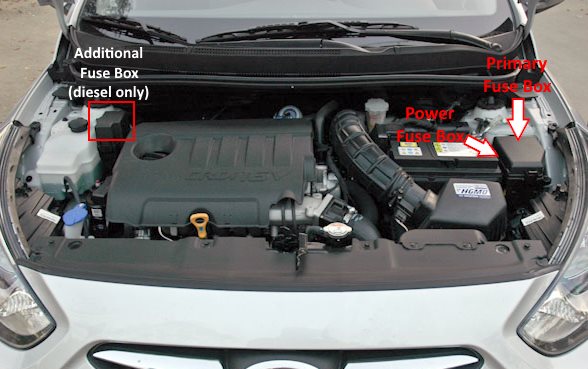
Depending on the engine configuration (gasoline or diesel), up to three fuse and relay units may be located under the hood.
Primary Fuse Box

Located on the right side of the engine compartment, adjacent to the battery.
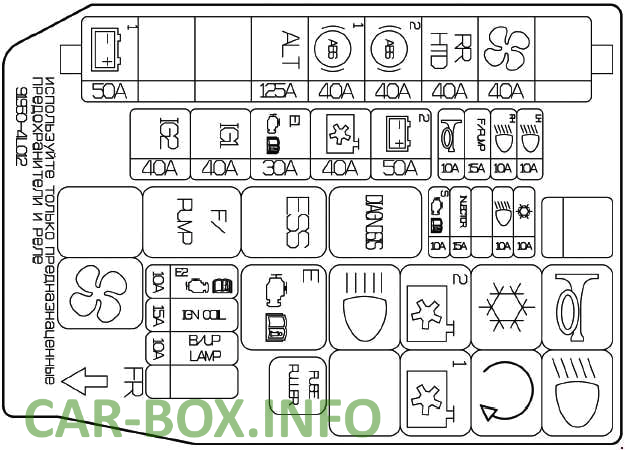
Example cover diagram schematic.
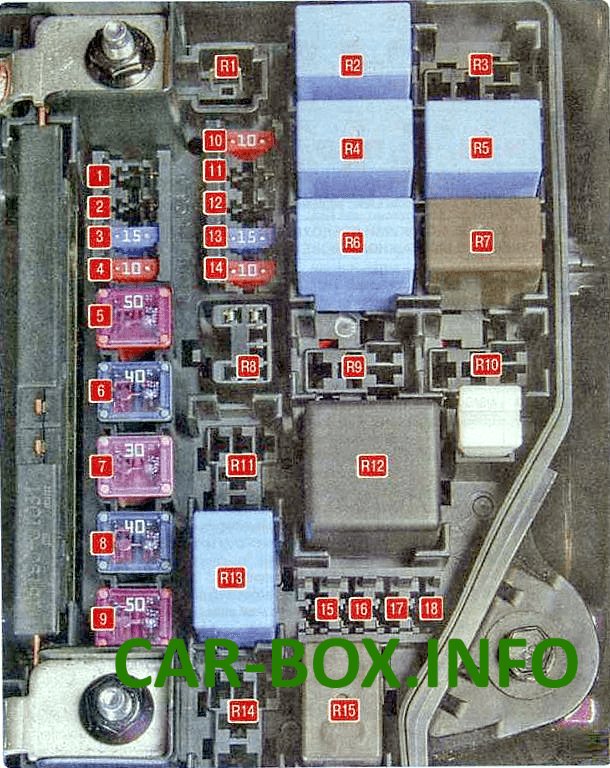
| Diagram | ||
|---|---|---|
|
||
| No. | Circuit Protected | A |
| 1 | Spare | - |
| 2 | Spare | - |
| 3 | F / PUMP - Fuel pump fuse | 15 |
| 4 | HORN - Horn relay / dual horns | 10 |
| 5 | B + 2 - Smart Junction Box: hazard warning switch, power windows, central door locking, fuses F23-F25, F31, F32 | 50 |
| 6 | C / FAN - HVAC blower control unit | 40 |
| 7 | ECU 1 - Engine Control Module (ECM), relay 1, fuse F25 | 40 |
| 8 | IG1 - Ignition switch, Body Control Module (BCM), shift interlock module, engine start/stop button module | 40 |
| 9 | IG2 - Ignition switch, Body Control Module (BCM), shift interlock module, engine start/stop button module | 50 |
| 10 | A / CON - Air conditioning compressor control | 10 |
| 11 | Spare | - |
| 12 | Spare | - |
| 13 | INJECTOR - Engine Control Module (ECM), Transmission Control Module (TCM), fuel pump relay, oil control valve (OCV) | 15 |
| 14 | Sensor - Engine Control Module (ECM), camshaft position sensor, oxygen sensor, immobilizer, A/C compressor relay, cooling fan relays (low/high speed), purge control solenoid valve | 10 |
| 15 | ECU 2 - Engine Control Module (ECM) | 10 |
| 16 | Spare | - |
| 17 | B / UP LP - Transmission Control Module (TCM), transmission range switch, instrument cluster, back-up lamp assembly | 10 |
| 18 | WIPER - Windshield wiper motor | 10 |
| R1 | Spare | |
| R2 | Horn relay | |
| R3 | Ignition switch relay, Body Control Module (BCM), shift interlock module, engine start/stop button module | |
| R4 | A/C compressor relay | |
| R5 | Starter interlock relay | |
| R6 | Radiator fan relay (low speed) | |
| R7 | Radiator fan relay (high speed) | |
| R8 | Data Link Connector (DLC) relay | |
| R9 | Ignition switch relay | |
| R10 | Ignition switch relay, Body Control Module (BCM), shift interlock module, engine start/stop button module | |
| R11 | Parking brake warning relay | |
| R12 | Engine Control Module (ECM) relay | |
| R13 | Fuel pump relay | |
| R14 | Spare | |
| R15 | Radiator cooling fan relay | |
Auxiliary Fuse Box
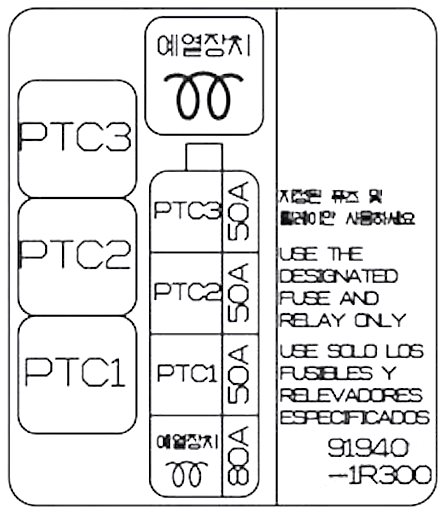
Installed on diesel engine models only.
High-Current Fuse Block (Fusible Link)
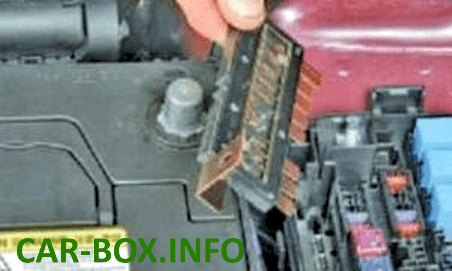
Mounted on the side of the main fuse box, containing high-current fusible links.
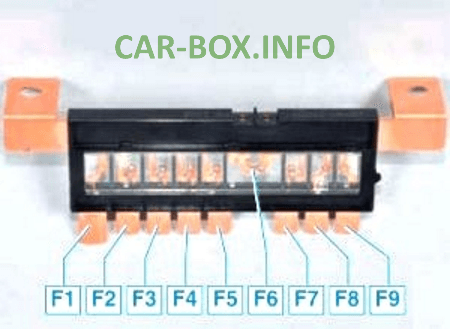
- F1 - Tail lamp relay 50 A;
- F2 - Spare;
- F3 - Spare;
- F4 - Alternator 125 A;
- F5 - ABS module, Data Link Connector (DLC) 40 A;
- F6 - ABS module 40 A;
- F7 - Rear window defroster relay 40 A;
- F8 - Radiator fan relay 40 A;
- F9 - Spare.
Passenger Compartment Fuse Box

Located behind the protective access panel on the driver-side lower dashboard.
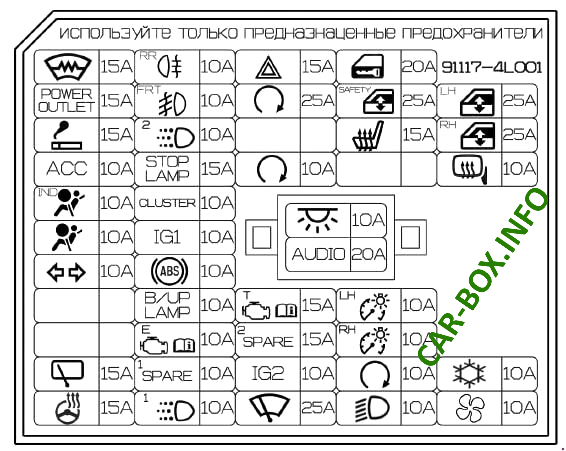
Diagram label on the interior panel cover.
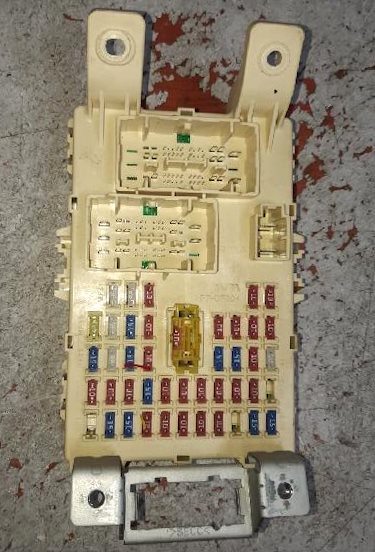
General view of the Hyundai Accent IV passenger compartment fuse box.
| Diagram | ||
|---|---|---|

|
||
| No. | Description | Amps |
| 1 | FRT-Deicer - Windshield wiper de-icer | 15 |
| 2 | P / OUTLET - Auxiliary 12V power outlet | 15 |
| 3 | C / LIGHTER - Cigarette lighter | 10 |
| 4 | ACC - Accessory power switch: audio system, Body Control Module (BCM), shift interlock module, Smart Key module | 10 |
| 5 | A / BAG IND - Front passenger airbag off indicator | 10 |
| 6 | A / BAG - Supplemental Restraint System (SRS) / Airbag control module | 10 |
| 7 | T / SIG - Turn signal lamps | 10 |
| 8 | Spare | - |
| 9 | Spare | - |
| 10 | R / WPR - Rear window wiper motor, multifunction switch | 15 |
| 11 | Spare | - |
| 12 | RR (R / FOG) - Rear fog lamps | 10 |
| 13 | FRT (F / FOG) - Front fog lamps | 10 |
| 14 | ROOM 2 - Battery saver / power cutoff relay | 10 |
| 15 | STOP LP - Stop lamps (brake lights) | 15 |
| 16 | CLUSTER - Instrument cluster | 10 |
| 17 | IG1 1 - Anti-theft / security system control module | 10 |
| 18 | ABS - Hydraulic Electronic Control Unit (HECU / ABS module) | 10 |
| 19 | B / UP LP - Back-up (reversing) lamp switch | 10 |
| 20 | PCU - Body Control Module (BCM), shift interlock module, Smart Key control module | 10 |
| 21 | H / LP LH - Left headlamp | 10 |
| 22 | DAY TIME RUNNING LIGHT - Daytime running lights (DRL) | 10 |
| 23 | HAZARD - Hazard warning switch | 15 |
| 24 | SMK 1 - Smart Key module, Body Control Module (BCM), shift interlock module | 25 |
| 25 | Spare | - |
| 26 | SMK 2 - Smart Key module, Body Control Module (BCM), shift interlock module, engine start/stop button switch | 10 |
| 27 | TCU - Transmission Control Unit (TCU), vehicle speed sensor, transmission range switch, pulse generator | 15 |
| 28 | IGN COIL - Ignition coils 1-4, ignition capacitor | 15 |
| 29 | IGN 2 - Power window relay, sunroof control module | 10 |
| 30 | F / WPR - Front windshield wiper motor | 25 |
| 31 | DOOR LOCK - Central door lock control unit | 20 |
| 32 | SAFETY P / WDW - Power window safety module | 25 |
| 33 | S / HEATER - Heated front seats | 15 |
| 34 | Spare | - |
| 35 | ROOM 1 - Interior lamps, A/C control unit | 10 |
| 36 | AUDIO - Audio head unit | 20 |
| 37 | TAIL LH - Left tail lamp, left side marker, license plate illumination | 10 |
| 38 | TAIL RH - Right tail lamp, right side marker, switch illumination, instrument panel lighting, shift selector light | 10 |
| 39 | START - Starter relay, burglar alarm relay | 10 |
| 40 | H / LP RH - Right headlamp | 10 |
| 41 | P / WDW LH - Left power window control switch / module | 25 |
| 42 | P / WDW RH - Right power window control switch / module | 25 |
| 43 | HTD MIRR - Heated exterior rear-view mirrors | 10 |
| 44 | A / CON 2 - Air conditioning control unit | 10 |
| 45 | Spare | - |

Relays located on the rear of the panel.
- MK1 - Rear window defroster relay;
- MK2 - Front fog lamp relay;
- MK3 - Rear fog lamp relay;
- MK4 - Side / tail lamp relay;
- MK5 - Interior illumination relay;
- MK6 - Windshield de-icer relay;
- MK7 - Central door locking relay;
- MK8 - Spare;
- MK9 - Spare;
- MK10 - Hazard / turn signal flasher relay;
- MK11 - Power window relay;
- MK12 - Spare;
- MK13 - Emergency Stop Signal (ESS) control relay (mounted externally)

Good