
The Toyota Prius was launched in 1997 as a groundbreaking hybrid vehicle. According to the manufacturer, it was the world’s first mass-produced hybrid automobile, combining an internal combustion engine with an electric motor. During its initial production years, the Prius was exclusive to the Japanese market; however, following the release of the updated version in 2000, the sedan was introduced globally, including in Europe. The model line featured a single powertrain configuration: a 1.5-liter inline four-cylinder gasoline engine producing 70 hp paired with a 33 kW electric motor.

The diagrams above apply to first-generation restyled Toyota Prius (chassis code NHW11; MC platform) models produced from 2000 through 2003.
Passenger Compartment
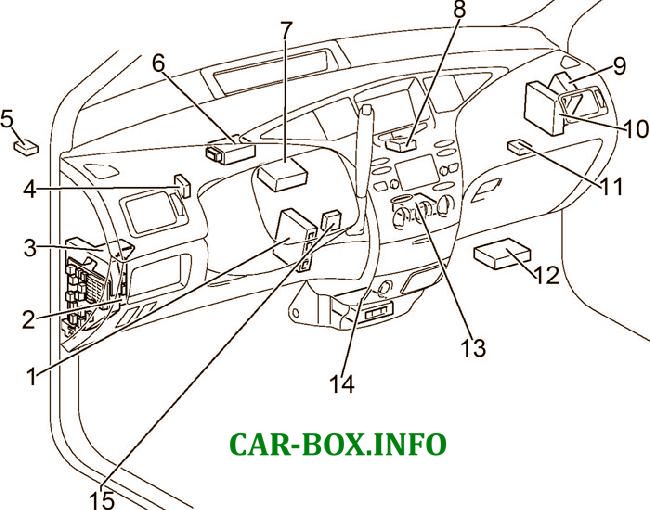
Component Locations: 1. Brake Control ECU; 2. Body Control Module (BCM); 3. Interior Fuse Box; 4. Daytime Running Light (DRL) Relay; 5. Turn Signal / Hazard Flasher Relay; 6. Key Transponder ECU; 7. Wireless Door Lock / Central Locking Receiver; 8. Network Gateway ECU; 9. Electric Power Steering (EPS) ECU; 10. Engine Control Module (ECM); 11. Reverse Light Relay; 12. Hybrid System Control ECU; 13. Air Conditioning Amplifier / ECU; 14. Airbag Control Module (SRS ECU); 15. Shift Lock Control ECU
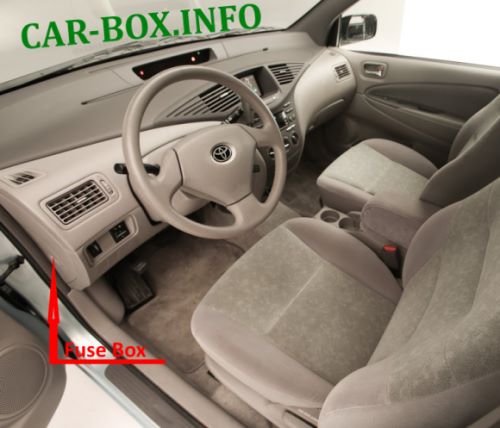
Main Fuse Box Location (LHD & RHD)

General view.
| Diagram | ||
|---|---|---|
|
||
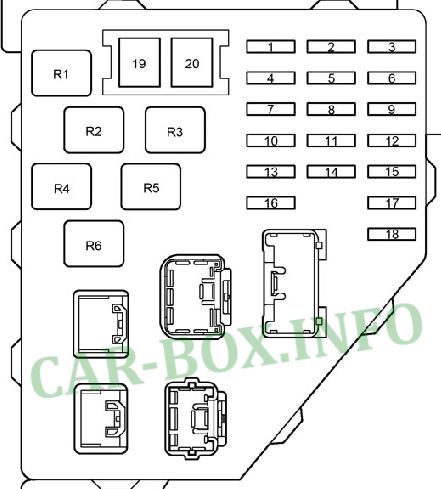
| No. | Circuit / Function | Rating (A) |
| 1 | Audio system, ashtray illumination, headlight leveling control, hazard warning lights | 5 |
| 2 | Instrument cluster, security alarm, rear window defogger, service indicators, warning buzzer, reverse lights, power windows, air conditioning system | 10 |
| 3 | Air conditioning system | 10 |
| 4 | Clearance / tail lamps, license plate light | 7.5 |
| 5 | Air conditioning system, ABS, electric power steering (EPS), daytime running lights (DRL) | 5 |
| 6 | Stop lamps, high-mount stop lamp, ABS | 15 |
| 7 | ABS warning indicator, clock, audio system, multi-information display (MID), shift lock system | 10 |
| 8 | Windshield wipers | 30 |
| 9 | Air conditioning system, daytime running lights (DRL), electric power steering (EPS), engine immobilizer system | 7.5 |
| 10 | Cigarette Lighter / Power Socket | 15 |
| 11 | Windshield washer pump | 15 |
| 12 | Central locking system | 30 |
| 13 | Airbags (SRS), seat belt pretensioners | 10 |
| 14 | Empty | - |
| 15 | Diagnostic Link Connector (OBD-II) | 7.5 |
| 16 | Empty | - |
| 17 | Power windows | 20 |
| 18 | Fuses: "ACC", "CIG", "SRS ACC", "WASHER", "HTR", "WIPER", "ECU-IG", "GAUGE" | 5 |
| 19 | Rear window defogger | 40 |
| 20 | Power windows | 30 |
| Relays | ||
| R1 | Ignition Relay (IG1) | |
| R2 | Tail Lamp Relay (TAIL) | |
| R3 | Accessory Relay (ACC) | |
| R4 | Empty | |
| R5 | Power Window Relay | |
| R6 | Rear Window Defogger Relay (DEF) | |
Engine Compartment


Component Locations: 1. Main fuse box; 2. Auxiliary fuse box; 3. Relay box
Fuse Box No. 1
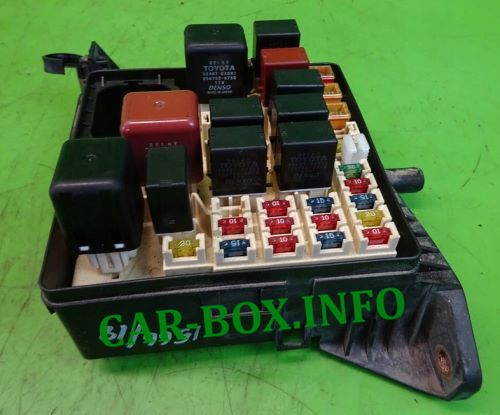
General view.
| Diagram | ||
|---|---|---|
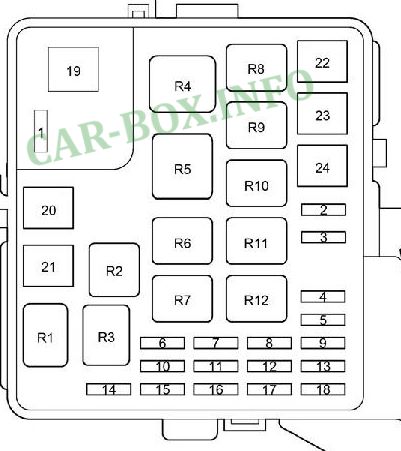
|
||
| No. | Circuit / Function | Rating (A) |
| 1 | Empty | - |
| 2 | Empty | - |
| 3 | Empty | - |
| 4 | Air conditioning system | 30 |
| 5 | Horn | 10 |
| 6 | Empty | - |
| 7 | Daytime running lights (DRL): Right high beam | 10 |
| 8 | Starter system, multiport fuel injection system (MFI) / sequential multiport fuel injection system (SFI), engine immobilizer | 15 |
| 9 | Electronic throttle control system | 15 |
| 10 | Right headlight | 10 |
| Daytime running lights (DRL): Right low beam | 10 | |
| 11 | Daytime running lights (DRL): Left high beam | 10 |
| 12 | Hybrid battery cooling fan | 10 |
| 13 | Brake booster pump | 20 |
| 14 | Hybrid system control | 20 |
| 15 | Multiport fuel injection system (MFI) / sequential multiport fuel injection system (SFI) | 15 |
| 16 | Left headlight | 10 |
| Daytime running lights (DRL): Left low beam | 10 | |
| 17 | Audio system, multi-information display (MID), interior lighting, trunk light, power windows, wireless remote control system | 15 |
| 18 | Turn signals, hazard warning lights | 10 |
| 19 | Fuses: "ACC" relay, "IG1" relay, "TAIL" relay, "ABS NO. 4", "HTR1", "HTR2", "ABS NO. 1", "HTR3", "EMPS", "CDS FAN", "RDI", "HTR", "OBD II", "ECU-B", "STOP", "PWR1", "POWER", "DOOR", "DEF", "AM1" | 100 |
| 20 | Daytime running lights (DRL) | 30 |
| Models without DRL: Jumper link | - | |
| 21 | Empty | - |
| 22 | Air conditioning system | 50 |
| 23 | Radiator cooling fan | 30 |
| 24 | Brake booster pump | 30 |
| Relays | ||
| R1 | Daytime running lights (DRL): Dimmer Relay (DIM) | |
| Models without DRL: Jumper link | ||
| R2 | Headlight Relay (HEAD) | |
| R3 | Circuit Opener / Fuel Pump Relay (C/OPN) | |
| R4 | Heater Relay (HTR) | |
| R5 | Daytime Running Light Relay / Jumper link | |
| R6 | Engine Control / EFI Main Relay (EFI) | |
| R7 | A/C Compressor Magnetic Clutch Relay (CLR MG) | |
| R8 | Cooling Fan Relay No. 1 (FAN NO. 1) | |
| R9 | Cooling Fan Relay No. 2 (FAN NO. 2) | |
| R10 | Cooling Fan Relay No. 3 (FAN NO. 3) | |
| R11 | Ignition Relay No. 2 (IG2) | |
| R12 | Horn Relay | |
Auxiliary Fuse Box No. 2
Diagram.
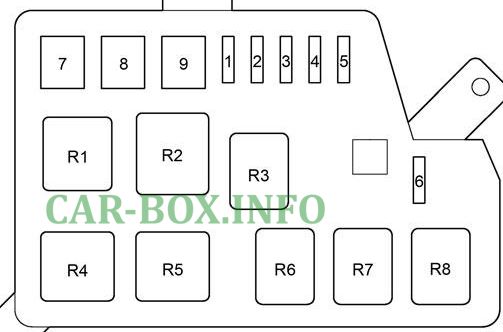
|
||
| No. | Circuit / Function | Rating (A) |
| 1 | ABS system | 10 |
| 2 | Air conditioning system | 30 |
| 3 | Empty | - |
| 4 | Air conditioning system | 30 |
| 5 | Empty | - |
| 6 | Daytime running lights (DRL) | 7.5 |
| 7 | Air conditioning system | 50 |
| 8 | Electric power steering (EPS) | 50 |
| 9 | ABS system | 40 |
| Relays | ||
| R1 | Daytime Running Light Relay (DRL) | |
| R2 | ABS Solenoid Relay (ABS SOL) | |
| R3 | A/C Water Pump Relay (A/C W/P) | |
| R4 | Electric Power Steering Relay (EMPS) | |
| R5 | PTC Heater Relay No. 3 (HTR3) | |
| R6 | Empty | |
| R7 | PTC Heater Relay No. 1 (HTR1) | |
| R8 | PTC Heater Relay No. 2 (HTR2) | |
Relay Box No. 3
Diagram.
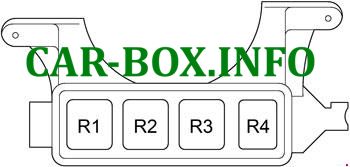
|
|
| R1 | ABS Hydraulic Motor Relay No. 1 (HYDRO MTR NO. 1) |
| R2 | ABS Hydraulic Motor Relay No. 2 (HYDRO MTR NO. 2) |
| R3 | Empty |
| R4 | Ignition Control Relay (IGCT) |
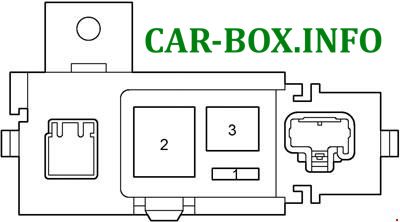
Luggage Compartment & Rear Body
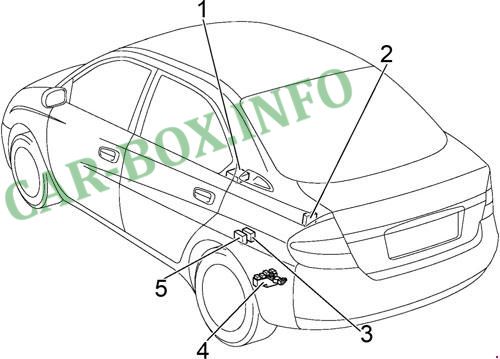
Component Locations : 1. Navigation ECU; 2. Hybrid battery cooling fan relay; 3. High-voltage (HV) battery ECU; 4. High-current fuse block; 5. System main relay
High-Current Fuse Block No. 4
(Item No. 4 in diagram)
| Diagram | ||
|---|---|---|
|
||
| No. | Circuit / Function | Rating (A) |
| 1 | Inverter / converter assembly | 5 |
| 2 | MAIN Fuses: "DC/DC", "BATT FAN", "HORN", "TURN-HAZ", "DOME", "THRO", "EFI", "AM2", "ABS NO. 2", "ABS NO. 3", "DC/DC-S", "HV", "HEAD" | 120 |
| 3 | Empty | - |
